
Fire is occurring much more frequently and burning far larger areas in the western Oregon Cascades in the last decade than at any time in the last 100 years. Managers and policy makers are in need of empirical data about the effects of common silvicultural practices in order to design stand- and landscape-scale adaptation strategies for the new fire normal.
The Ecosystem Workforce Program is partnering with Sustainable Northwest, the Southern Willamette Forest Collaborative, and the Willamette National Forest to establish a network of long-term monitoring plots in stands slated for thinning to increase forest resilience, accelerate development of late successional habitat, produce timber volume to support local economies, and reduce fuels to help better manager future fires. Long-term monitoring helps build stakeholder support for thinning and provides information that informs adaptive management.
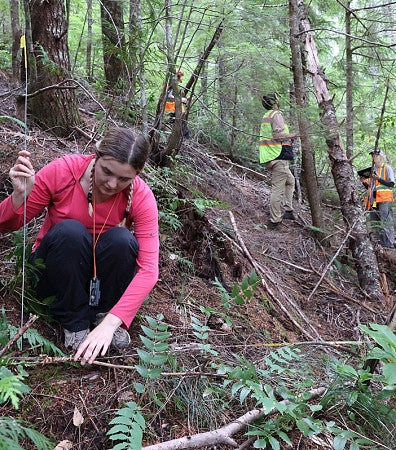
We've employed a dozen undergraduate field technicians who collect detailed information about overstory tree structure, understory species diversity, and surface fuel loading in four different project areas across the 1.7 million acre Willamette National Forest. We have completed two years of data collection and will complete another year's worth of data collection in the summer of 2027.
We hope to secure funding to complete at least 10 more years' worth of data collection to better understand how thinning influences forest diversity and wildfire behavior. This data will make an important contribution to ongoing efforts to adapt the highly productive, Douglas-fir dominated forests of west Oregon to wildfire.
We're also conducting opinion surveys to better understand how stakeholders perceive wildfire risk and the potential for thinning and other silvicultural actions to increase resilience of forest to fire.
Ecosystem Workforce Program Researchers
- Project Director: James Johnston, PhD, is an assistant research professor in the Institute for Resilient Organizations, Communities, and Environments at the University of Oregon.
- Michael Coughlan, PhD, is an associate research professor and co-director of the Ecosystem Workforce Program in the Institute for Resilient Organizations, Communities, and Environments at the University of Oregon.
- Stephanie Schneider is a faculty research assistant in the Ecosystem Workforce Program at the University of Oregon.